Prokaryotic cells
Bacteria and archaea lack a membrane-bound nucleus. Their DNA occupies a nucleoid region, while ribosomes operate in the cytoplasm.
 lilernoScience
Opening Lilerno
Biology · Unit 01
Cells share basic components, but different cell types organize them in different ways. Eukaryotic organelles create specialized compartments, while the plasma membrane controls exchange with the environment.
Bacteria and archaea lack a membrane-bound nucleus. Their DNA occupies a nucleoid region, while ribosomes operate in the cytoplasm.
Animals, plants, fungi, and protists have a membrane-bound nucleus and specialized membrane-bound organelles.
Visual learning
These original Lilerno figures simplify the structures so their relationships are easier to recognize. They are illustrative models, not microscope images and not drawn to scale.
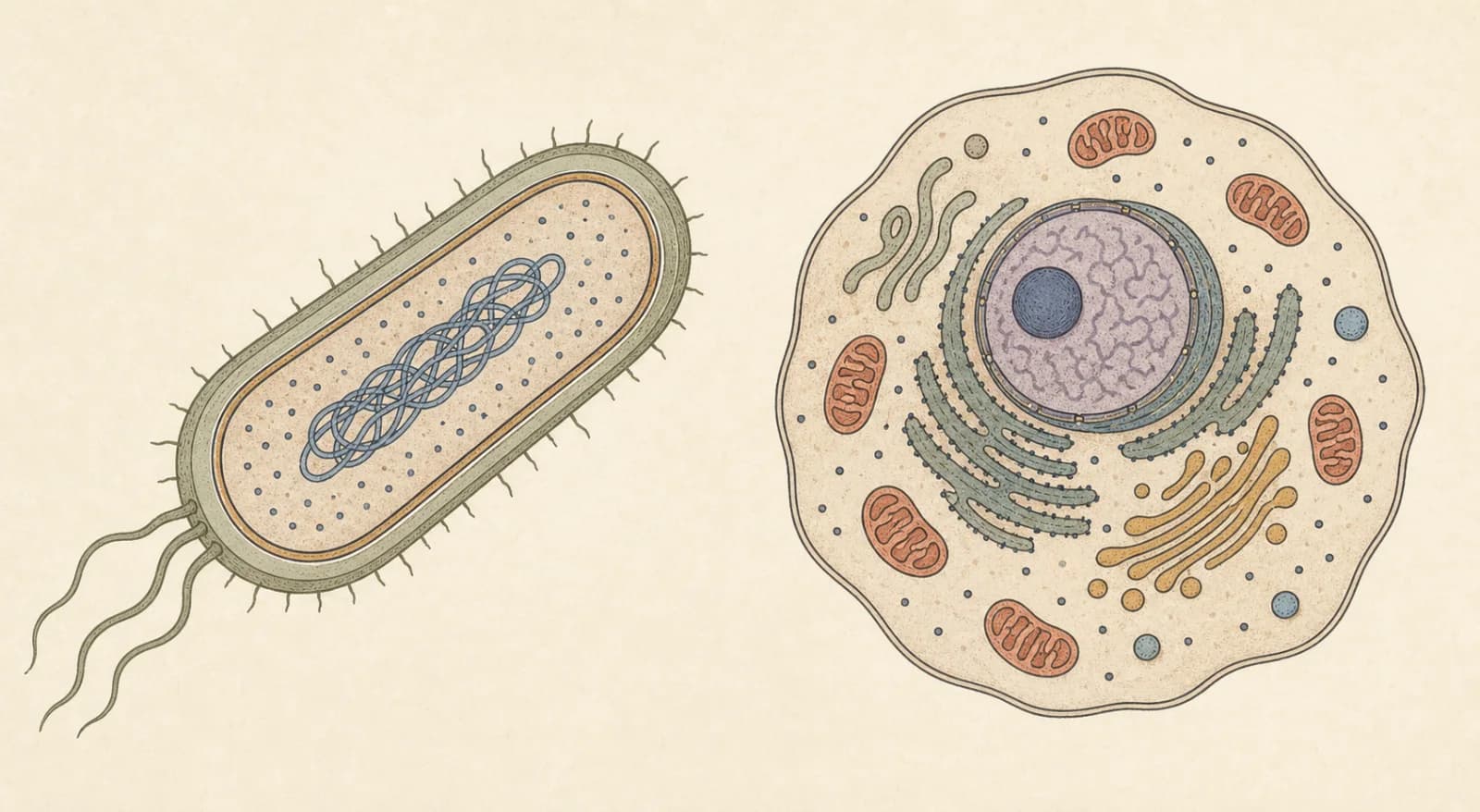
Lilerno original illustration · not to scale
The bacterial cell keeps its DNA in a nucleoid region and has no membrane-bound nucleus. The animal cell separates DNA inside a nucleus and organizes specialized work across membrane-bound organelles.
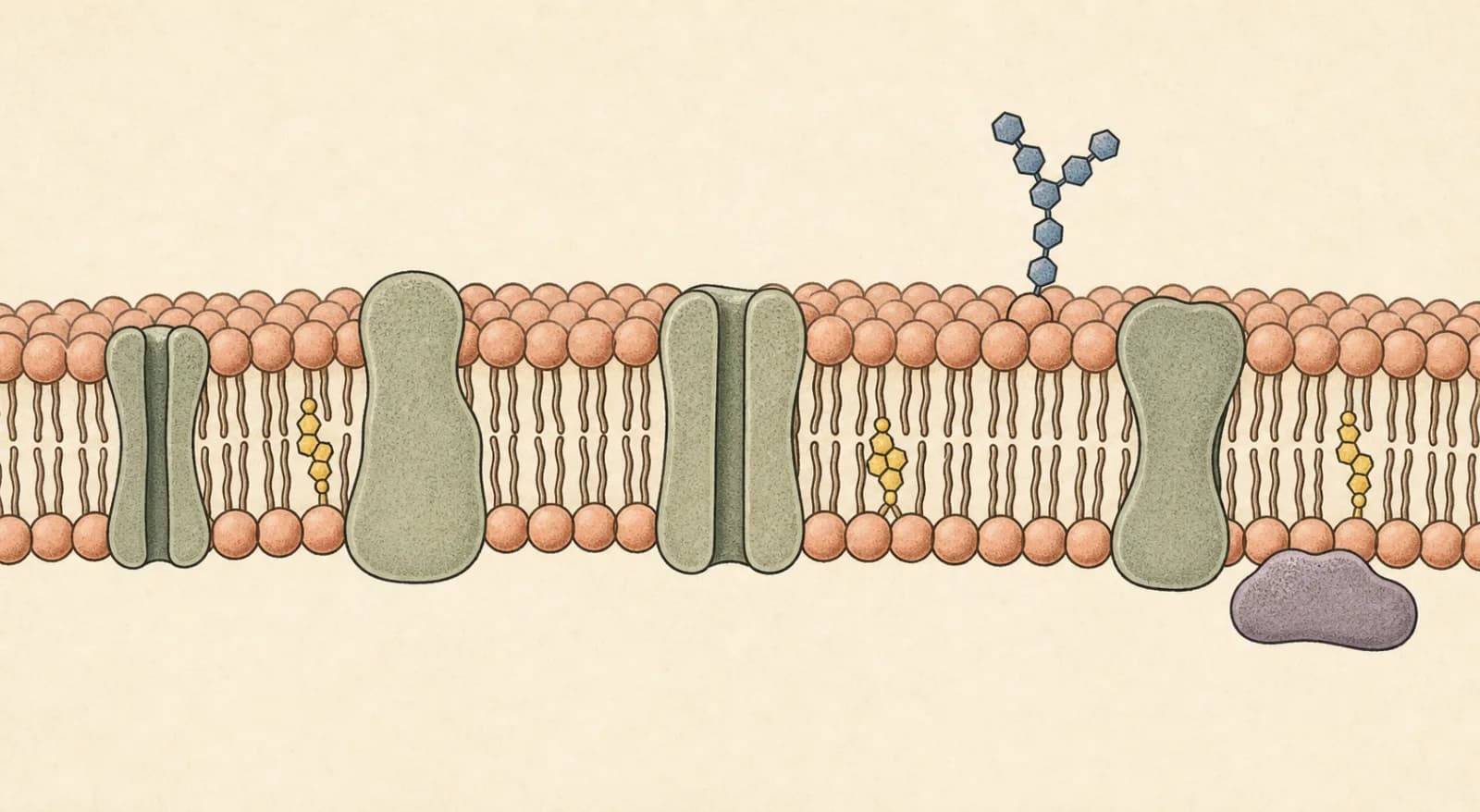
Lilerno original illustration · not to scale
Hydrophilic phospholipid heads face watery environments while hydrophobic tails point inward. Proteins, cholesterol, and exterior carbohydrate groups contribute to transport, stability, signaling, and recognition.
Retrieval practice
Answer each question before opening the card. Every answer identifies the educational reference used for fact checking.
A cell.
Organisms may contain one cell or many cells, but cellular organization is the basic structural level of living systems.
A plasma membrane, cytoplasm, genetic material (DNA), and ribosomes.
Prokaryotic and eukaryotic cells arrange these components differently, but both cell types depend on them.
Eukaryotic cells have a membrane-bound nucleus; prokaryotic cells do not.
Prokaryotic DNA occupies a nucleoid region rather than a nucleus surrounded by a nuclear envelope.
It contains the cell's DNA and helps direct gene expression, including the production of RNA and proteins.
The nuclear envelope separates the genome from the cytoplasm while pores regulate traffic between them.
They synthesize proteins by translating information carried by messenger RNA.
Ribosomes may be free in the cytosol or associated with the rough endoplasmic reticulum.
They produce much of the cell's ATP through aerobic cellular respiration.
ATP transfers usable chemical energy to many cellular processes; mitochondria are not simply storage containers for energy.
Ribosomes attached to its surface create the rough appearance; it helps produce proteins destined for membranes or secretion.
New proteins enter or associate with the endoplasmic-reticulum system before further processing and transport.
It participates in lipid synthesis.
Smooth ER lacks surface-bound ribosomes and can also have specialized roles that vary by cell type.
It modifies, sorts, and packages them for delivery to other cellular destinations.
The Golgi is part of the endomembrane trafficking system rather than the site where all proteins are initially synthesized.
It controls which substances cross between the cell and its environment.
The membrane forms a flexible boundary whose lipids and proteins support transport, communication, and recognition.
They use digestive enzymes to break down macromolecules and worn cellular material.
The lysosomal membrane keeps these enzymes separated from most of the cytoplasm.
Photosynthesis.
Chloroplasts capture light energy to support the synthesis of energy-rich organic molecules in plants and algae.
Outside the plasma membrane.
The wall adds structural support, while the plasma membrane remains the selective boundary controlling molecular movement.
Water in the vacuole helps maintain internal pressure against the cell wall.
The central vacuole also stores dissolved substances and occupies a large fraction of many mature plant cells.
Cytosol is the fluid portion; cytoplasm includes the cytosol and cellular structures between the plasma membrane and nuclear envelope.
Using the terms interchangeably can hide the distinction between the fluid medium and the larger cellular region.
Source transparency
Lilerno wrote the lesson and cards in original language. These materials were used only to check scientific facts; their text, diagrams, and media are not reproduced.
OpenStax, Rice University
Authors: Mary Ann Clark, Matthew Douglas, Jung Choi
Referenced for fact checking: OpenStax, Biology 2e, section 4.1, OpenStax at Rice University. Lilerno does not reproduce its text or media.
OpenStax, Rice University
Authors: Mary Ann Clark, Matthew Douglas, Jung Choi
Referenced for fact checking: OpenStax, Biology 2e, section 4.2, OpenStax at Rice University. Lilerno does not reproduce its text or media.
OpenStax, Rice University
Authors: Mary Ann Clark, Matthew Douglas, Jung Choi
Referenced for fact checking: OpenStax, Biology 2e, section 4.3, OpenStax at Rice University. Lilerno does not reproduce its text or media.
OpenStax, Rice University
Authors: Mary Ann Clark, Matthew Douglas, Jung Choi
Referenced for fact checking: OpenStax, Biology 2e, section 5.1, OpenStax at Rice University. Lilerno does not reproduce its text or media.